

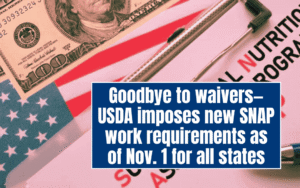
The U.S. Department of Agriculture (USDA) has posted a stark notice warning that federal food assistance will not be distributed on November 1, escalating fears among millions of low-income Americans as the government shutdown continues.
The announcement signals that the Supplemental Nutrition Assistance Program (SNAP) — which supports roughly one in eight Americans — may soon run out of funds.
USDA Confirms SNAP Funding Has Dried Up
In a statement published on its website, the USDA said it will not issue any SNAP benefits next month. “Bottom line, the well has run dry,” the notice reads.
The department placed blame squarely on the ongoing political gridlock, adding, “We are approaching an inflection point for Senate Democrats.” The message marks a serious escalation in the budget impasse that began October 1.
A Shutdown with Real Consequences
Now entering its fourth week, the shutdown is the second-longest in U.S. history. Although the administration initially ensured SNAP benefits were covered through October, the new cutoff will dramatically widen the shutdown’s impact.
Without a quick resolution, millions of families could lose access to essential grocery assistance within days — a move that state officials warn could deepen food insecurity nationwide.
Funding Refusal Sparks Outrage
The Trump administration recently announced it would not use approximately $5 billion in contingency funds to sustain the program into November.
Those funds, according to the USDA, are legally reserved for emergencies such as natural disasters — not for a “man-made” government shutdown. Critics say that decision amounts to withholding life-sustaining aid for political leverage.
Congressional Tensions Escalate
Democrats argue that the USDA has both the authority and moral obligation to release the funds. Several Democratic lawmakers have written to Agriculture Secretary Brooke Rollins, urging her to deploy contingency money to cover the majority of next month’s SNAP benefits.
Republicans, however, insist Democrats must first agree to reopen the government before any broader budget negotiations can begin.
Debate Over Contingency Funds
A USDA memo released Friday stated that “contingency funds are not legally available to cover regular benefits.” Instead, the agency said, the money must remain available for emergency programs like Disaster SNAP, which aids people affected by hurricanes or floods.
The memo even cited Hurricane Melissa — now a major storm — as an example of why those funds must remain untouched.
States Struggle to Prepare
The looming cutoff has left state governments scrambling. SNAP is federally funded but state-administered, meaning governors and local agencies must handle implementation.
Some states, including Virginia and Minnesota, have pledged to cover benefits temporarily with state funds, though the USDA has warned those costs won’t be reimbursed. Many other states lack the resources to fill the federal gap.
Widespread Anxiety Across the Nation
Officials in states such as Arkansas and Oklahoma are already advising residents to prepare for the worst. Agencies there have begun directing SNAP recipients to local food banks, pantries, and community programs.
Even states with stronger budgets say they can only sustain emergency coverage for a few weeks — leaving millions of families uncertain about how they’ll afford food next month.
Political Blame Game Intensifies
Republican leaders continue to argue that Democrats are holding essential services hostage by refusing to support a spending bill that would reopen the government.
Democrats counter that Republicans caused the shutdown by attaching partisan measures — including rollbacks to Affordable Care Act subsidies — to the funding legislation. Each side insists the other is responsible for prolonging the crisis.
A Plea for Negotiation
Democratic Senator Chris Murphy of Connecticut criticized the administration’s unwillingness to negotiate, calling the standoff unnecessary.
“The reality is, if they sat down to try to negotiate, we could probably come up with something pretty quickly,” Murphy said Sunday on CNN’s State of the Union. “We could open up the government on Tuesday or Wednesday, and there wouldn’t be any crisis in the food stamp program.”
The Human Cost of Political Gridlock
For millions of Americans, the political finger-pointing in Washington translates to an immediate and painful reality: empty refrigerators. SNAP provides critical grocery assistance to working families, seniors, and children.
The potential cutoff would not only increase hunger but also strain local economies, as grocery stores in lower-income communities depend heavily on SNAP dollars.
A Growing Sense of Urgency
With only days left before the November 1 deadline, lawmakers are under mounting pressure to strike a deal. Advocacy groups are warning that hunger relief organizations will be overwhelmed if benefits stop.
Unless Congress and the White House find a compromise soon, millions of households could face the first widespread suspension of federal food aid in modern U.S. history.


