

Over 40 million low-income Americans who rely on food stamps may soon see their grocery budgets shrink—or disappear entirely.
As the government shutdown drags on, the U.S. Department of Agriculture (USDA) is warning that billions in Supplemental Nutrition Assistance Program (SNAP) funds will not be released if the stalemate continues into November.
Billions Withheld Despite Emergency Funds
Experts estimate between $5 billion and $6 billion remain in USDA’s SNAP contingency fund, enough to provide partial aid to struggling families.
But the agency has declared it will not tap those funds after October 31, effectively holding back money Congress already approved for emergency use. The decision escalates pressure on Senate Democrats to back a GOP spending bill.
A Controversial Legal Justification
In a memo obtained by Axios, USDA argued that using contingency funds during a political shutdown would be illegal. The document claims the fund is meant for natural disasters—like hurricanes and floods—not “manufactured” crises caused by political gridlock.
The agency said the situation does not qualify as an unforeseen emergency and thus cannot legally trigger the fund.
Contradictions and Policy Shifts
That stance contradicts USDA’s earlier shutdown plan, which stated the department was legally obligated to continue SNAP payments using multi-year contingency funds. The original policy emphasized Congress’s intent to maintain operations during a shutdown.
However, that guidance has since been removed, signaling a major shift in the agency’s position under Secretary Brooke Rollins.
Democrats Denounce the Move
Democrats and hunger advocates are blasting the USDA for what they call a political maneuver that punishes low-income families. Sharon Parrott of the Center on Budget and Policy Priorities said the agency “could have, and should have, taken steps weeks ago” to use the funds.
Instead, she said, the administration is choosing to use hunger as leverage in a political standoff.
States Brace for Impact
States administer the SNAP program, but federal dollars fund the benefits themselves. Without access to contingency money, many states are warning that benefits could be paused as early as November 1.
From Texas to New York, local agencies have begun notifying residents of potential delays or cuts, leaving millions uncertain about how they’ll afford food next month.
Unequal State Responses
Some states, like Virginia, have announced plans to temporarily use state funds to keep benefits flowing. Yet the USDA has made clear it will not reimburse those expenses. Many states simply can’t afford to fill the gap, especially smaller or less wealthy ones already struggling with budget shortfalls.
Democrats Accuse Administration of Weaponizing Hunger
Democratic lawmakers on Capitol Hill condemned the USDA’s decision as “cruel and unlawful.” In a joint statement, Reps. Rosa DeLauro of Connecticut and Angie Craig of Minnesota accused the Trump administration of deliberately worsening the shutdown’s impact.
“Freezing funding already enacted into law to feed hungry Americans is perhaps the most cruel offense yet,” they said.
Selective Funding Raises Questions
Critics note that while USDA refuses to draw on SNAP contingency funds, it has found ways to sustain other programs—like the Special Supplemental Nutrition Program for Women, Infants, and Children (WIC).
To prevent an earlier funding shortfall, the administration diverted $300 million from tariff revenues to support WIC, but that funding is expected to expire soon as well.
The Politics Behind the Shutdown
President Trump and Budget Director Russell Vought have framed the shutdown as a chance to downsize the federal government. Trump has called it an “unprecedented opportunity” to cut spending, saying he intends to target programs “favored by Democrats.”
Critics argue that SNAP, which primarily aids children, seniors, and veterans, should not be used as a bargaining chip.
SNAP Changes Add to the Strain
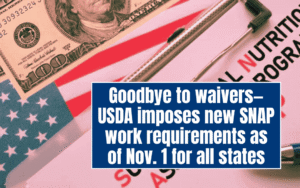
The uncertainty comes on top of major changes to SNAP enacted under the GOP’s “One Big Beautiful Bill Act,” which included new work requirements and eligibility limits.
Republicans argue those reforms will reduce fraud and waste, but advocates warn they’ve already made it harder for vulnerable Americans to qualify for aid.
Republicans Shift Blame to Democrats
GOP leaders now insist they want to reopen the government to ensure food aid continues. “It’s unconscionable that millions of Americans are being held as leverage,” House Speaker Mike Johnson said.
He emphasized that over 40 million people rely on SNAP and accused Democrats of blocking funding that could restore those benefits immediately.
Democrats Call Out Hypocrisy
Democrats counter that Republicans forfeited the moral high ground when they passed what House Minority Leader Hakeem Jeffries called “the largest SNAP cut in American history.”
The recent GOP budget law slashed $186 billion from the program while delivering tax breaks to the wealthy. “And now they claim to care about hunger?” Jeffries said Friday at the Capitol.
A Looming Crisis for Millions
With no resolution in sight, the clock is ticking for families already living paycheck to paycheck. Unless Congress breaks the impasse soon, millions could lose access to essential food assistance within weeks.
Advocates warn the damage will ripple far beyond individual households—hurting grocery stores, food banks, and local economies that depend on SNAP dollars.


