
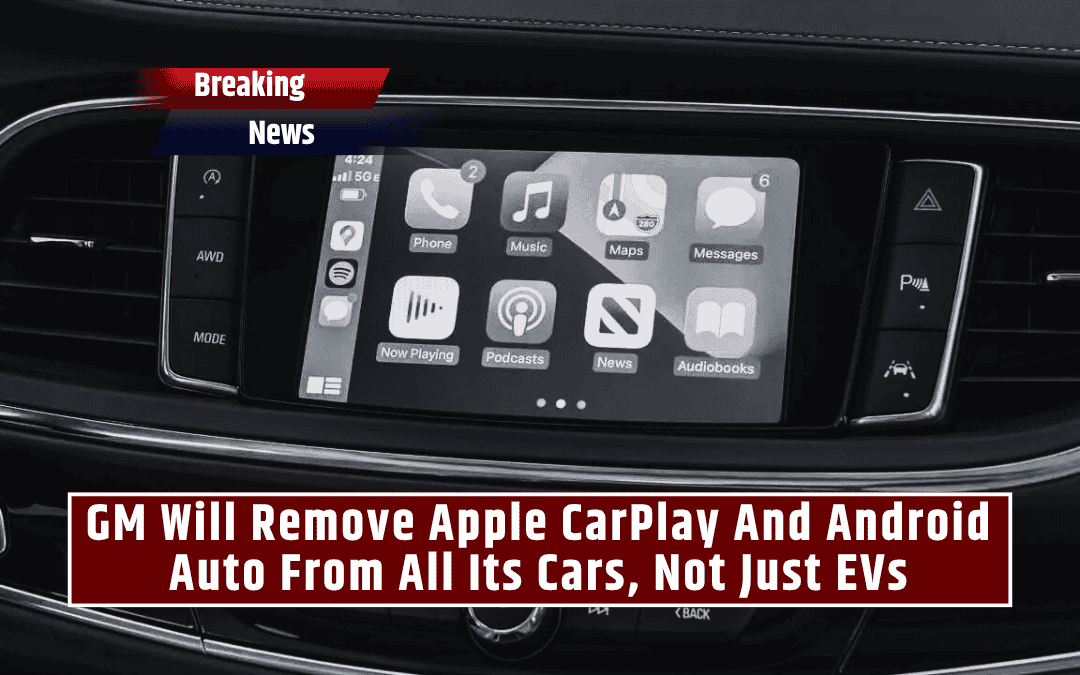
General Motors is taking a bold step toward greater software control by phasing out support for Apple CarPlay and Android Auto in all its vehicles over the coming years. The decision, confirmed by CEO Mary Barra on The Verge’s Decoder podcast, extends a move first applied to GM’s electric vehicles beginning in 2023.
From Electric Models to the Entire Lineup
Initially, GM dropped smartphone projection support in its new electric vehicles, including the Cadillac Lyriq and GMC Hummer EV. These were the only U.S. EVs in the company’s portfolio to launch with CarPlay and Android Auto compatibility.

Meanwhile, all of GM’s gas-powered cars continued to offer both systems—a point that has drawn criticism from many drivers and tech enthusiasts.
A Broader Rollout Ahead
According to Barra, the company’s new policy will eventually apply to all GM vehicles, not just electric models. As gasoline-powered vehicles undergo mid-cycle refreshes or major redesigns, they too will lose CarPlay and Android Auto.
“We have over 40 models across our portfolio,” Barra explained, “and as each one updates, you’re going to see us be consistent on that.”
Customer Feedback Drove the Decision

Barra said the shift was largely informed by feedback from drivers who found switching between the vehicle’s native infotainment system and smartphone projection “clunky” and distracting.
“It wasn’t seamless,” she said, “and in some cases, it could be distracting to move back and forth between what was available on the phone projection versus what you needed to do in the vehicle.”
A Unified Digital Experience
GM’s decision reflects its broader strategy to deliver a unified in-car digital ecosystem rather than relying on third-party integrations. Barra noted that the company’s new Android Automotive-based infotainment systems are designed to provide a smoother, more integrated experience.

Unlike Android Auto, Android Automotive runs natively in the car, allowing direct access to Google apps and services without connecting a phone.
Challenges with the New System
While the Android Automotive platform brings certain advantages, it also introduces inconveniences. Owners must sign in separately to each app, a process that can feel tedious.
Sterling Anderson, GM’s Chief Product Officer, acknowledged this issue on the podcast and said the company is developing a more seamless login experience, though details and a timeline were not disclosed.
Concerns for Apple Users
The biggest concern comes from iPhone owners, who may find themselves at a disadvantage in GM’s future vehicles. Many popular iOS apps won’t be available on Google’s platform, limiting functionality.
Anderson admitted the app ecosystem is still growing but insisted that more native apps will arrive over time. “The list of available apps will expand,” he said, emphasizing that development is ongoing.
A Bold but Controversial Comparison
Anderson likened GM’s decision to a classic Apple moment, referencing Steve Jobs’ controversial removal of the disk drive from early MacBooks. “Nobody liked that at first,” Anderson said, “but Jobs told people, ‘Flash storage is the future.
Get on board.’ That’s exactly what we’re saying here.” GM believes its software-driven approach will ultimately prove more forward-thinking and efficient for drivers.
Industry Shift Toward Software Integration
GM’s strategy mirrors a broader industry trend. Automakers increasingly seek to control their digital ecosystems rather than depend on Apple and Google for user interfaces.
This allows companies to gather valuable data, deliver updates remotely, and create subscription-based services—all of which play central roles in the future of connected, software-defined vehicles.
No Changes for Current Owners
Despite the upcoming transition, GM stressed that current vehicles with Apple CarPlay and Android Auto will retain full functionality. “We are not making any changes to existing vehicles,” a company spokesperson told InsideEVs.
“If your car supports Apple CarPlay or Android Auto, that will continue.” The company said both systems will remain in gas-powered models “for the foreseeable future.”
A Gradual Evolution, Not a Sudden Shift
GM emphasized that this transition will occur gradually. “As we advance toward our centralized computing platform,” the spokesperson added, “we’ll move to a more deeply integrated experience—a direction the broader industry is taking as vehicles become more software-defined.
This will happen over time, not overnight.” The automaker underscored its ongoing collaboration with both Apple and Google.
Balancing Innovation and Customer Expectations
While the decision aligns with GM’s long-term vision, it also risks alienating customers who prefer the familiarity and reliability of CarPlay and Android Auto.
Analysts note that many drivers consider these systems essential, offering seamless integration with navigation, music, and messaging apps. GM’s challenge will be to prove that its native software can deliver the same level of convenience and trust.
A Defining Moment for GM’s Digital Future
The shift marks one of GM’s most consequential technology decisions in recent years. By betting on in-house software, the company hopes to strengthen its position in an increasingly digital automotive landscape.
If successful, it could redefine the relationship between carmakers and technology providers, positioning GM as a leader in the race toward the fully connected vehicle of the future.


